


Short ribs are built for slower cooking rather than a quick sear. Give the beef time and gentle heat until it becomes tender.


SHORT RIBS AT A GLANCE
Short ribs need time.
Short ribs need time.
Not complicated
technique.
A clear look at the cut, the package, storage, and the kind of cooking that lets short ribs do what they do best.


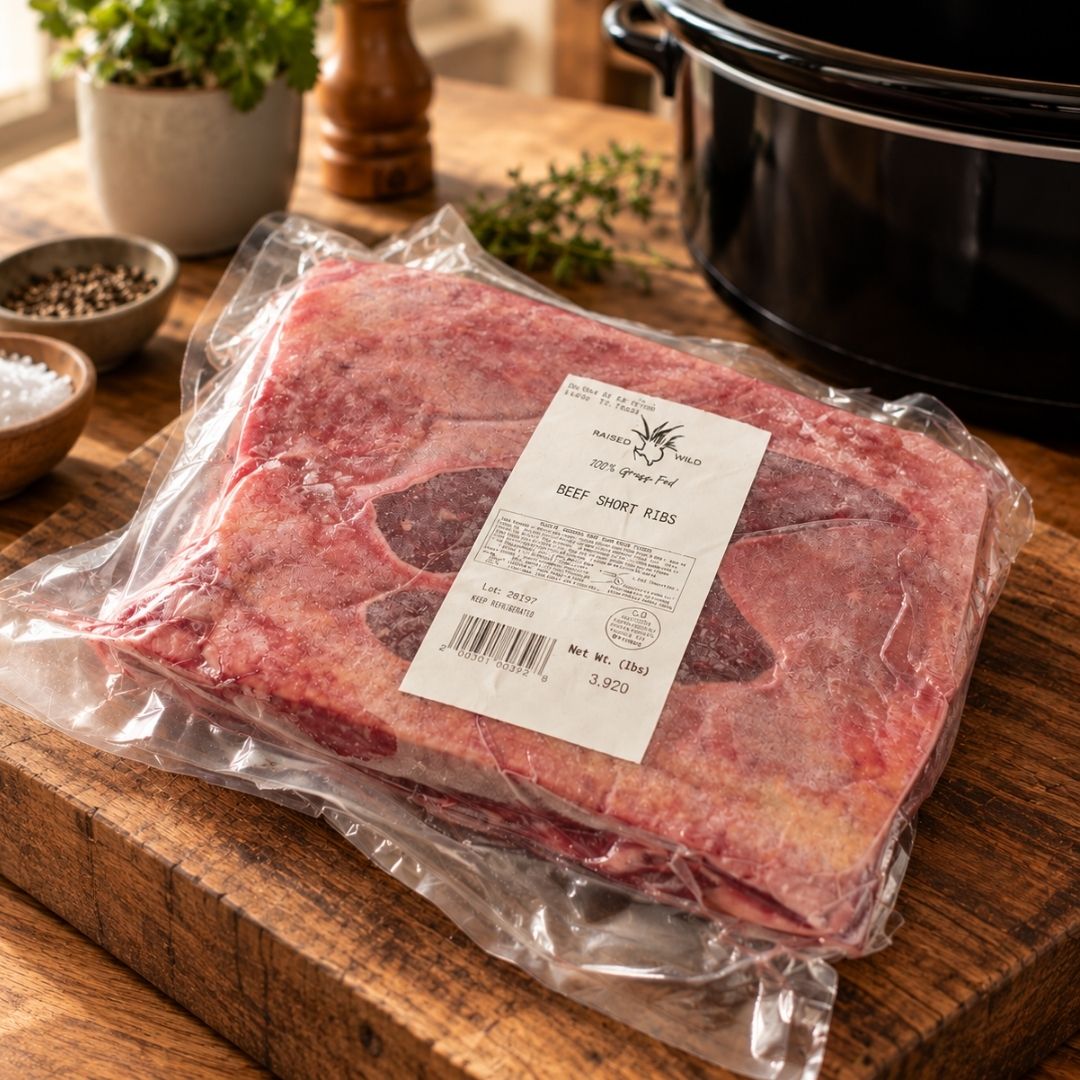
Each frozen package contains beef short ribs. Current package options run approximately 3.1–4.3 lb; choose from the available weights above.
ROCK delivers the beef frozen. Keep it frozen until needed, then thaw it in the refrigerator before cooking.
Braise in a Dutch oven, use a slow cooker, or cook under pressure. The goal is steady cooking until the beef is tender.
You don’t need a smoker to make beef short ribs.
Beef short ribs might look like barbecue food, but one of the easiest ways to cook them is in a slow cooker or crockpot. Season them, add a few simple ingredients, and give them time.
NO SMOKER
NO GRILL
NO COMPLICATED TECHNIQUE
01 / START HERE
Short ribs are made for slower cooking.
Bone and connective tissue are part of the cut. That is why short ribs respond so well to steady, gentle cooking instead of the quick sear you would use for a steak.
02 / SLOW COOK
Stack them in the crockpot.
Season the ribs and arrange them in the slow cooker so they fit comfortably, stacking them when needed. Add onions, garlic, herbs, and a little braising liquid, cover, and let low, steady heat do the work.
KEEP IT SIMPLE
Browning the ribs first can add another layer of flavor, but it is optional. You do not need an extra pan, a smoker, or a grill to make a tender dinner.

03 / SERVE
Cook until the meat yields easily.
Short ribs are ready when the meat is very tender and begins to pull away from the bone. Exact timing varies with the size of the ribs and your slow cooker, so tenderness matters more than a fixed number of hours.
THE SIMPLE VERSION
Beef short ribs can be a slow-cooker family dinner.
The barbecue-joint version is only one way to enjoy beef ribs. At home, a slow cooker turns the cut into a hands-off meal you can serve with mashed potatoes, roasted carrots, or whatever else is already going on your family’s table.
NEXT: THE RANCH
The cooking can be simple. The story behind the beef begins with Raised Wild Texas.

RAISED WILD TEXAS · ITALY, TEXAS
THE RANCH BEHIND THE BEEF
Three to four years
means a lot of seasons.
Raising cattle over that length of time means committing land, water, forage, attention, and daily work long before the animal reaches maturity.
Conditions do not stay the same for three or four years. Rain changes what grows. Heat changes water needs. Seasons change the pasture. The cattle keep growing through all of it, so the ranch has to keep responding.
THE WORK BEHIND IT
Someone has to
make the call.
Water has to be watched. Forage has to be managed. Cattle have to be observed and moved. The health of the herd has to be tended to.
Raised Wild keeps its cattle on grass and other forage, with water, from beginning to end rather than switching them to grain for finishing. Standards on a label are easy to list. Living them out for three or four years is the work.
01
100%
GRASS-FED + GRASS-FINISHED
02
3–4
YEARS TO MATURE
03
~8
WILD ACRES PER ANIMAL
04
200+
GRASSES + FORAGE
01
03
THE RANCH BEHIND THE BEEF
Three to four years means a lot of seasons.
Raising cattle over that length of time means committing land, water, forage, attention, and daily work long before the animal reaches maturity.
Conditions do not stay the same for three or four years. Rain changes what grows. Heat changes water needs. Seasons change the pasture. The cattle keep growing through all of it, so the ranch has to keep responding.
THE WORK BEHIND IT
Someone has to make the call.
Water has to be watched. Forage has to be managed. Cattle have to be observed and moved. The health of the herd has to be tended to.
Raised Wild keeps its cattle on grass and other forage, with water, from beginning to end rather than switching them to grain for finishing. Standards on a label are easy to list. Living them out for three or four years is the work.
01
100%
Grass-fed + grass-finished
02
3–4
Years to mature
03
~8
Wild acres per animal
04
200+
Grasses + forage

MEET THE PEOPLE BEHIND THE BEEF
Raised Wild Texas
Before the product, there was a person.
Barron Kidd and Ricky Langer are the people ROCK works with at Raised Wild Texas.
When we have a question about the herd, the pasture, or how the cattle are being raised, we know who to ask. Knowing the people behind the food gives the standards on the package a person responsible for the work.
HOW THIS BEEF IS RAISED
100% grass-fed & grass-finished · grass + other forage + water · no grain · closed herd · no antibiotics · no vaccines · no added hormones
Know the rancher.
Honor the food.
Gather the family.
QUESTIONS FROM THE TABLE
Beef Short Ribs,
answered.
Answers about the cut, cooking, package size, Raised Wild Texas, and how ROCK serves Dallas–Fort Worth.
BEFORE YOU ORDER0108
01What are beef short ribs?
02Are short ribs a quick-cooking steak?
03How do I know when short ribs are done?
04Should I brown them first?
05How is the package sized?
06How are Raised Wild Texas cattle raised?
07Who is behind Raised Wild Texas?
08How does ROCK deliver beef short ribs in Dallas–Fort Worth?
READY TO CHOOSE YOUR PACKAGE?
Choose the available weight or quantity that fits your household.
THE ANSWER01 / 08
THE PRODUCT
What are beef short ribs?
Beef short ribs are bone-in rib sections with meat and connective tissue that are best suited to slow cooking.
THE PRODUCT
Are short ribs a quick-cooking steak?
No. Beef short ribs are better suited to braising and other slow-cooking methods than to quick searing like a steak.
IN THE KITCHEN
How do I know when short ribs are done?
Short ribs are done when the connective tissue has softened and the meat yields easily. Exact cooking time depends on the size of the ribs and the method you use.
IN THE KITCHEN
Should I brown them first?
Browning is optional, but searing the short ribs before braising can add deeper browned flavor to the finished dish.
PRACTICAL DETAILS
How is the package sized?
Current frozen package options are approximately 3.1–4.3 lb. Choose the exact available weight shown on the product page.
THE CATTLE
How are Raised Wild Texas cattle raised?
Raised Wild Texas cattle are 100% grass-fed and grass-finished on grass and other forage, with water, from beginning to end. They are raised with no grain, antibiotics, vaccines, or added hormones.
THE PEOPLE
Who is behind Raised Wild Texas?
ROCK works with Barron Kidd and Ricky Langer at Raised Wild Texas in Italy, Texas. The ranch was established in 1961 and is now in its third generation.
RECEIVING YOUR ORDER
How does ROCK deliver beef short ribs in Dallas–Fort Worth?
ROCK serves Dallas–Fort Worth through scheduled local pickup and home delivery. Beef short ribs are delivered frozen; the fulfillment options available for your order are shown on the store.
READY TO CHOOSE YOUR PACKAGE?
Select the current available weight or quantity above.
FOR THE TABLE
Keep the rest of the meal simple.
Serve the short ribs with mashed potatoes, polenta, rice, or vegetables, and spoon some of the cooking liquid over the top. Once the beef is tender, there is not much left to do.